
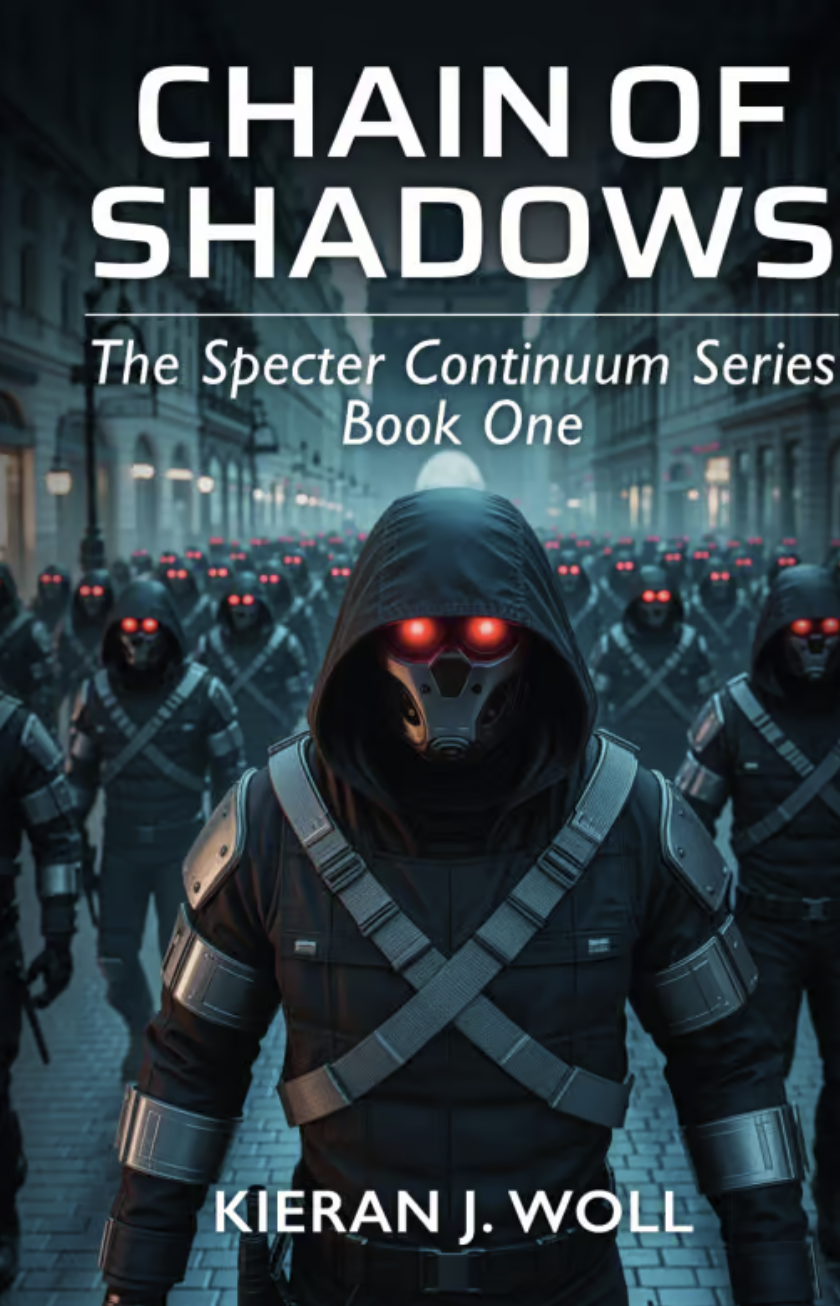
The espionage genre has long captivated readers who crave narratives layered with suspense, moral ambiguity, and the intoxicating tension of secrets held and revealed. Kieran J. Woll steps confidently into this tradition with a story that places human psychology at the center of a high-stakes intelligence operation, producing a thriller that lingers in the mind long after the final page.
At the heart of the narrative is Specter, a clandestine network so deeply embedded in the routines of everyday life that its operatives could be anyone, a neighbor, a colleague, a stranger at a train station. This is the challenge that confronts Drake, the team leader whose strategic mind and controlled demeanor mask a growing unease about the nature of the war he is fighting. Alongside Voss, whose tactical precision is matched only by a dry pragmatism, and Raven, whose instincts for reading people border on preternatural, Drake pursues Specter across the underbelly of Europe in a campaign defined by deception at every turn.
Woll's approach to the genre reflects a writer who understands that the most compelling espionage stories are not about explosions and car chases but about the quiet, devastating moments when an operative realizes that the intelligence they trusted was fabricated, or that an ally has been compromised. The narrative is built on these moments of reckoning, creating a rhythm that alternates between careful planning and sudden, disorienting upheaval.
The author's background as a versatile storyteller spanning fiction, science fiction, and crime and mystery genres is evident in the narrative's construction. Woll employs techniques drawn from multiple literary traditions, blending the procedural rigor of crime fiction with the speculative imagination of science fiction and the emotional depth of literary fiction. The result is a story that feels familiar enough to satisfy genre enthusiasts yet fresh enough to attract readers who might not typically reach for a spy thriller.
One of the narrative's most compelling elements is its treatment of trust as both a weapon and a vulnerability. Within Drake's team, trust is not given but continuously tested. Each operative carries personal histories and private motivations that occasionally conflict with the collective mission, and Woll handles these internal tensions with a subtlety that prevents the characters from becoming archetypes. They are flawed, capable, and recognizably human in their contradictions.
Specter itself is rendered not as a monolithic villain but as a distributed threat that mirrors the complexities of real-world intelligence challenges. The network operates through influence rather than brute force, manipulating information flows and exploiting institutional weaknesses. This makes it a particularly insidious antagonist, one that cannot be defeated by simply capturing a leader or destroying a headquarters.
The European settings serve as more than backdrop. Each location carries its own history of espionage and political intrigue, and Woll draws on these associations to create an atmosphere thick with paranoia and possibility. The cities through which Drake and his team move are characters in their own right, shaping the story through their geography and their ghosts.
For readers aged twenty-five to sixty-five who appreciate espionage fiction that demands engagement rather than passive consumption, this narrative offers a deeply satisfying experience. Kieran J. Woll has produced work that honors the genre's finest traditions while pushing its boundaries in thoughtful and compelling directions. The story invites readers not just to follow a mission but to question the very nature of the shadows in which such missions unfold.
CONTACT: https://readerdepot.com/book-author/26579/